
千山暮雪
Reliance on Taiwan Chipmaker Puts US Economy at Risk Amid China Tensions_我的网站

A | Tensions between China and Taiwan boiled over last week after US House Speaker Nancy Pelosi ignored Beijing’s warnings and visited Taipei. Beijing reacted by launching large-scale military exercises, which disrupted global supply chains, as the foreign ministry warned that Taiwan’s reunification with China was historically inevitable.,The US does not officially recognize Taiwan’s independence, and supposedly embraces a "One China" policy, but Washington’s diplomatic relations and arms sales to the island have been condemned by Beijing for years. US lawmakers, adding fuel to the fire ignited by Pelosi, have been working on legislation that would provide Taiwan with $4.5 billion in security aid in addition to granting the island non-NATO ally status.,Four days before Pelosi’s trip, Chinese leader Xi Jinping in a phone call warned President Joe Biden that the US was "playing with fire," and now was not the time for a full-blown crisis over Taiwan.,In light of the current over-reliance on Taiwan, many companies within several sectors of the US economy would likely agree with Xi.,In a bid to reduce dependence on the island, the US government will be investing billions on projects to develop domestic semiconductor capabilities. However, former senior US diplomat Chas Freeman believes China may be better positioned in the long run to penetrate this highly-concentrated market in the race for microchip self-sufficiency.,"The United States still has the capacity and resources to out-compete China but it still has not done so," Freeman, who was President Richard Nixon’s translator during his 1972 visit to Beijing, told Sputnik. "On the contrary, 19 of the world’s 20th fastest growing semiconductor companies are now in mainland China and none are in the United States.",US Vulnerabilities Run Abroad and Deep,Last year, the US economy lost $240 billion due to the global microchip shortage, and a war over Taiwan would be even more devastating for the United States due to its dependence on one single supplier: Taiwan Semiconductor Manufacturing Company (TSMC), the world’s largest chip foundry.,TSMC accounted for more than half of the $100 billion semiconductor manufacturing market in 2021, and makes more than 90% of the world’s most advanced microchips, according to the Capital Economics research group. And the company’s market share is only likely to expand. TSMC executives in a July earnings call projected 30% growth this year, which would put total annual revenue well over $70 billion.,American tech giants like Apple, Intel, NVIDIA, Qualcomm, AMD, and Broadcom, all rely on TSMC, while the US government depends on the Taiwanese supplier for some of the most critical and complex systems.,The Energy Department’s Argonne National Laboratory, a byproduct of the Manhattan project, for example, is building a national security supercomputer using TSMC because Intel was forced to delay production.,US-China Tensions Over TaiwanPelosi Meets Chair of World’s Largest Chipmaker in Taiwan Amid Increasing US-Chinese Tensions3 August, 11:41 GMT,Moreover, TSMC makes semiconductors for high-end weapons systems and a wide range of military-grade devices, a major factor in the US pressuring TSMC to move production to America’s shores, the Center for Strategic and International Studies (CSIS) said in a June report.,The Biden administration in a supply chain review last summer even conceded that the United States is too heavily dependent on TSMC for producing America’s leading-edge semiconductors - a reality that led to the recently-passed CHIPS Act, signed by Biden on Monday, which provides more than $52 billion in subsidies for domestic manufacturers.,In July, former director of cybersecurity for the White House National Security Council, Zach Nunn, described the semiconductor shortage and lack of capacity as a "direct threat to America’s economy and national security.",Although Biden failed to prevent Pelosi's visit, he is apparently well aware of America’s vulnerabilities. The president stopped short of opposing the House Speaker publicly, but behind the scenes senior White House officials were dispatched to dissuade Pelosi from going, Bloomberg reported, and to halt the new bill that would provide billions in military aid to Taiwan.,Chip Race With China,Some experts have suggested China has shown restraint in punishing Taiwan economically because it could backfire. TSMC Chairman Mark Liu, who met Pelosi during her visit, told CNN Beijing will "think twice" about invading because China’s most advanced systems rely on his firm’s semiconductors. An invasion, Liu added, would render his company "not operable.",Part of the reason TSMC has an advantage is a near monopoly on the skill set needed to develop certain advanced microchips. This has been exacerbated by a global high-tech talent shortage amid soaring demand for software skills needed to program and integrate chips into fast-growing markets such as electric vehicles and robotics, according to a 2022 Deloitte industry outlook.,The US Chips Act allocates funding to develop these types of skills while Beijing has focused on enhancing such capabilities as part of the $1.4 trillion high tech investment plan it unveiled in 2020.,China Slams US Attempt to Ban Dutch Sales of Chipmaking Equipment6 July, 14:23 GMT,Although China today accounts for only 15% of global manufacturing in semiconductors, its chip companies are rapidly growing. Meanwhile, the US share of the market has dropped from 37% to 12%.,Freeman, who chairs an international business development firm, said Beijing’s aspirations go beyond simply developing manufacturing capabilities.,"The US still leads in chip design but China is also closing that gap rapidly and is already only a year or two behind us," Freeman said.,China, which currently produces one-third of global manufacturing, Freeman added, has the talent and skills to eventually take the lead in many technology and science-related sectors.,Freeman pointed out that Chinese universities produce four times as many students as the United States in science, technology, engineering, and math (STEM) - and the gap is widening.,"Many examples from history refute the complacent American assumption that only private companies in liberal democracies with free speech on political matters can be inventive," Freeman said. "History proves that myth is wrong. China is proving it is wrong again today."。
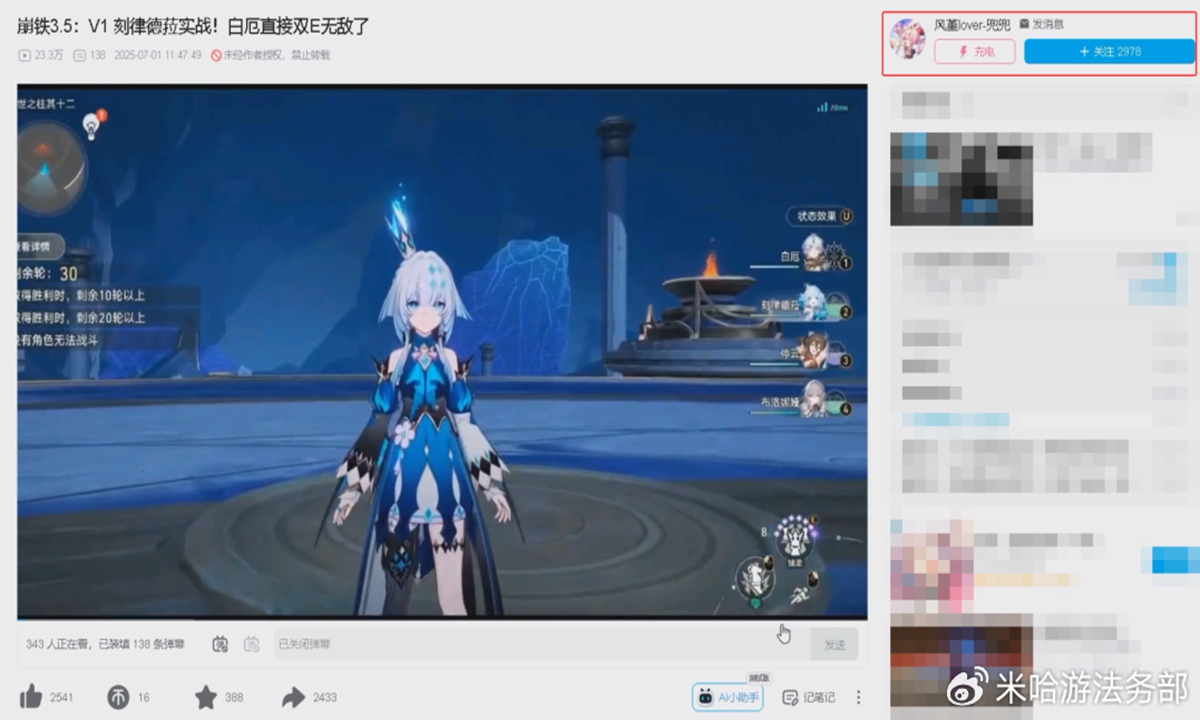
A criminal case involving information leaks related to miHoYo, the developer of Genshin Impact, has reached its first-instance verdict. Two Bilibili (Chinese video-sharing platform) users were found guilty of copyright infringement and were sentenced to one year and two months and one year in prison, respectively, both with probation. It is the first criminal game leak case under a new judicial interpretation issued by China's top judicial authorities, according to miHoYo.
The infringing videos uploaded by Su and Wu received more than 600,000 and 300,000 views, respectively, exceeding the criminal prosecution thresholds stipulated under the judicial interpretation. The court therefore found that the two individuals met the criteria for criminal prosecution and handed down guilty verdicts.
During routine monitoring, in July 2025, miHoYo discovered that Su and Wu had repeatedly uploaded gameplay videos featuring unreleased versions of miHoYo titles, including Genshin Impact, Honkai: Star Rail and Zenless Zone Zero, without any authorization from the company. The videos, widely circulated within gaming communities, exposed unreleased characters, skill animations and other content that had not yet been officially introduced to players, miHoYo noted.
After discovering the alleged violations, miHoYo reported the case to the police in accordance with legal procedures. Following an investigation, the police arrested the two individuals involved.
The case was publicly heard and the verdict was delivered on April 24, 2026. The court ruled that Su was to be sentenced to one year and two months in prison with probation, while Wu was sentenced to one year of detention with probation, according to miHoYo.
Guo Hao, a Beijing-based lawyer, told the Global Times on Thursday that a key significance of the case lies in its further clarification of how game leak cases can be assessed under the Criminal Law.
"In the past, game leaks were more often handled through civil infringement claims or breach-of-contract disputes. In this case, however, the court did not simply determine liability based on whether content was released ahead of schedule," Guo said. "Instead, it considered factors including the scale of dissemination, the nature of the leaked content and the impact caused, and determined that the conduct met the prosecution threshold for the crime of copyright infringement."
Similar game leak incidents have also occurred overseas in recent years. In October 2024, The Pokemon Company suffered a data breach that resulted in large amounts of internal information being leaked online, including employees' personal information, according to overseas media reports. Dubbed the "Teraleak" by the gaming community, the incident was reportedly one of the largest game-related leaks in recent years. The leaked materials reportedly included game source codes, details of future projects and other internal information, according to Nintendo Life, a UK-based gaming news outlet.
Earlier, Nintendo had pursued legal action over the leak of a Pokemon Sword and Shield strategy guide in 2019. According to gaming website Polygon, The Pokémon Company later reached a settlement with the two individuals responsible, who were required to pay $150,000 each in damages.
"From a player's perspective, there is a clear difference between game leaks and normal game discussions," Lu, a member from the Steam gaming community, told the Global Times on Thursday. "Players discussing and analyzing officially released information is part of gaming culture, but obtaining and spreading unreleased content through unauthorized channels can harm the efforts of developers and affect the experience of the entire player community."
Such concerns are also shared by game developers, who view unreleased content as a key part of their creative and commercial plans.
A post by miHoYo on its online account specifies that every unreleased frame of game content represents the design and refinement efforts of its creative teams, while also carrying players' expectations for upcoming updates. Unauthorized early exposure of such content not only infringes upon miHoYo's copyright interests, but also takes away the surprise that players should have when experiencing new content for the first time.
。
Current article:http://5xck2bw.chuanshaonianmokuanchouzhei.sbs/news/20260826_1003859.html
Published on:00:00:00
我的网站最新文章
- 石家庄锚定五大产业赛道 推动经济高质量发展
- 都是牛!纽约红牛官方发布抽象海报:红牛来了!
- 福彩快乐8,4.18亿大派奖倒计时3天
- 蓝思科技:具身智能板块预计下半年会实现更大幅度增长
- Bigg Boss 19 में बोल्ड हसीना की वाइल्ड कार्ड एंट्री, निशाने पर Tanya Mittal, कहा- 'कैमरे के सामने ब्लाउज...'
- Heritage crafts gain popularity as wedding gifts among young Chinese
- 车市需求“预冷” 特斯拉三季报敲响“警钟”:华尔街警告汽车行业或由盛转衰
- 外交部谈机器人大会:中国底层逻辑始终是开放合作、互利共赢 而非封闭独占
- 电竞拓宽新兴体育产业之路
- 泽连斯基重奖马斯克
- Man pleads guilty to murder in 2021 hit-and-run spree that killed steakhouse chef
- 游泳世锦赛:杨健杨昊10米台一金一铜 中国跳水包揽13金
- 接受“管家式”服务、大肆收钱敛财,新疆维吾尔自治区政协原副主席金之镇被公诉
我的网站随机推荐
- 银龄共富工坊点亮“夕阳红”
- Kung Fu Conference in Shaanxi brings together over 1,800 martial artists
- 四川红原县突发4.9级地震,附近居民称在睡梦中被摇醒,当地正排查灾情
- 阿里云国际站代理商:首月免费用 不限金额 云老大为您买单!
- 活力中国调研行丨“批量造星”照进现实:价格打下来,速度提上去
- 总决赛再迎考验 中国女排靠团队力拼意大利队
- 京东健康减重投诉
- 上百艘菲船来犯黄岩岛,中方出动19艘船舰,菲先遣队无功而返
- 4217万!26岁全明星被放弃?曝快船无理由续约加兰,5号秀才是真核
- 亲历美国高校抗议的中国留学生,毕业典礼被取消其实微不足道
- 武汉李先生:最后一刮,斩获40万头奖
- Journalist Names Circumstances for Abrupt End to Ukraine's US Support
- 难逃电气化,兰博基尼Aventador继任车型将搭载V12插混系统